Grants-First AI | by Zenius
AI for grants that you can audit.
AI that reasons the way an experienced grants professional does, with a person making every decision and a record behind every answer.
Why Grants-First AI
Grant dollars come with rules, audits, and a person who has to sign. General AI tools write fluently, are sometimes wrong, and can’t show how they reached an answer.
Zenius built Grants-First AI the other way around. It starts from the rules and the records, keeps a person in charge of every decision, records how it reached every answer, and runs as a layer above the systems you already have. We ran it on our own company first.
The rules we hold ourselves to
How we keep it honest
It starts from the rules.
Agents work from checkable sources: 2 CFR 200, EDGAR, funder guidance, the award record, the approved budget. No support, no conclusion.
A person signs.
AI drafts, sorts, checks, and flags. A named person decides. No agent approves an award, rules on eligibility, or certifies compliance.
One door for every model.
Every AI call goes through one gateway: swap models by configuration, see each call's cost, stop sensitive data at the door.
Someone else checks.
The agent that writes a result never grades it. A second agent, built to find problems, reviews it before a person sees it.
It shows its work.
Every number, score, and recommendation carries its source and reasoning. When an auditor asks why, the answer is on record.
- NIST AI RMF aligned
- C0 to C5 data classes enforced at the gateway
- Audit trail on every AI call and finding
- Human sign-off on every determination
Measure, manage, modernize, monitor
Four offerings, one discipline
1Measure
GMMI™
In useScores a grants operation on nine domains, including 2 CFR 200 compliance and AI readiness, on a five-level scale. Free Snapshot at gmmi.zeniuscorp.com.
Take the free Snapshot2Manage
Grants Managed Services
In deliveryLifecycle operations in four pillars, including audit support, in delivery today at a federal grant-making agency.
3Modernize
Grantech
In developmentReasoning agents above existing grants systems. First agent, NOFO Intelligence, gives a cited bid recommendation.
4Monitor
GrantIntel
In developmentTracks opportunities, amendments, and policy. Amendment Watch flags what changed, with a source on every claim.
Offerings 2 to 4 are powered by Grants-First AI.
Grantech
How Grantech is designed
Design preview. The platform layer runs at Zenius today. The reasoning agents are in development.
Philosophy
You keep your system of record, your data, and your workflows. Zenius adds reasoning, checking, and an audit trail on top.
Design
Agents reason over your own rules and records. Each output cites its source. Every AI call passes through one governed gateway.
What is different
Most grants software stores and tracks. Grantech is designed to analyze, recommend, and explain, and a person decides. It is designed to sit above existing platforms, such as Fluxx.
Agents prepare, people decide
Across the lifecycle
Stage 1
Competition planning
Agents: Opportunity analysis
Agent prepares
Drafts notice sections from statute, priorities, and prior competitions, with sources quoted.
You decide
Notice content and priorities.
Stage 2
Application review
Agents: Compliance advisor, Budget review
Agent prepares
Flags eligibility and budget issues against 2 CFR 200 and your policy, each with its citation.
You decide
Eligibility rulings and review scores.
Stage 3
Award
Agents: Budget review, Compliance advisor
Agent prepares
Drafts award conditions and a payment schedule tied to the budget and reporting calendar.
You decide
The award, approved and signed.
Stage 4
Monitoring and reporting
Agents: Performance reporting, Monitoring
Agent prepares
Reads every report, ranks reports at risk, and names where spending and progress drift apart.
You decide
Which grantees to call, and what action to take.
Stage 5
Audit and closeout
Agents: Audit readiness, Closeout
Agent prepares
Assembles the source and reasoning behind each finding; builds the closeout checklist.
You decide
Resolution of findings and closeout sign-off.
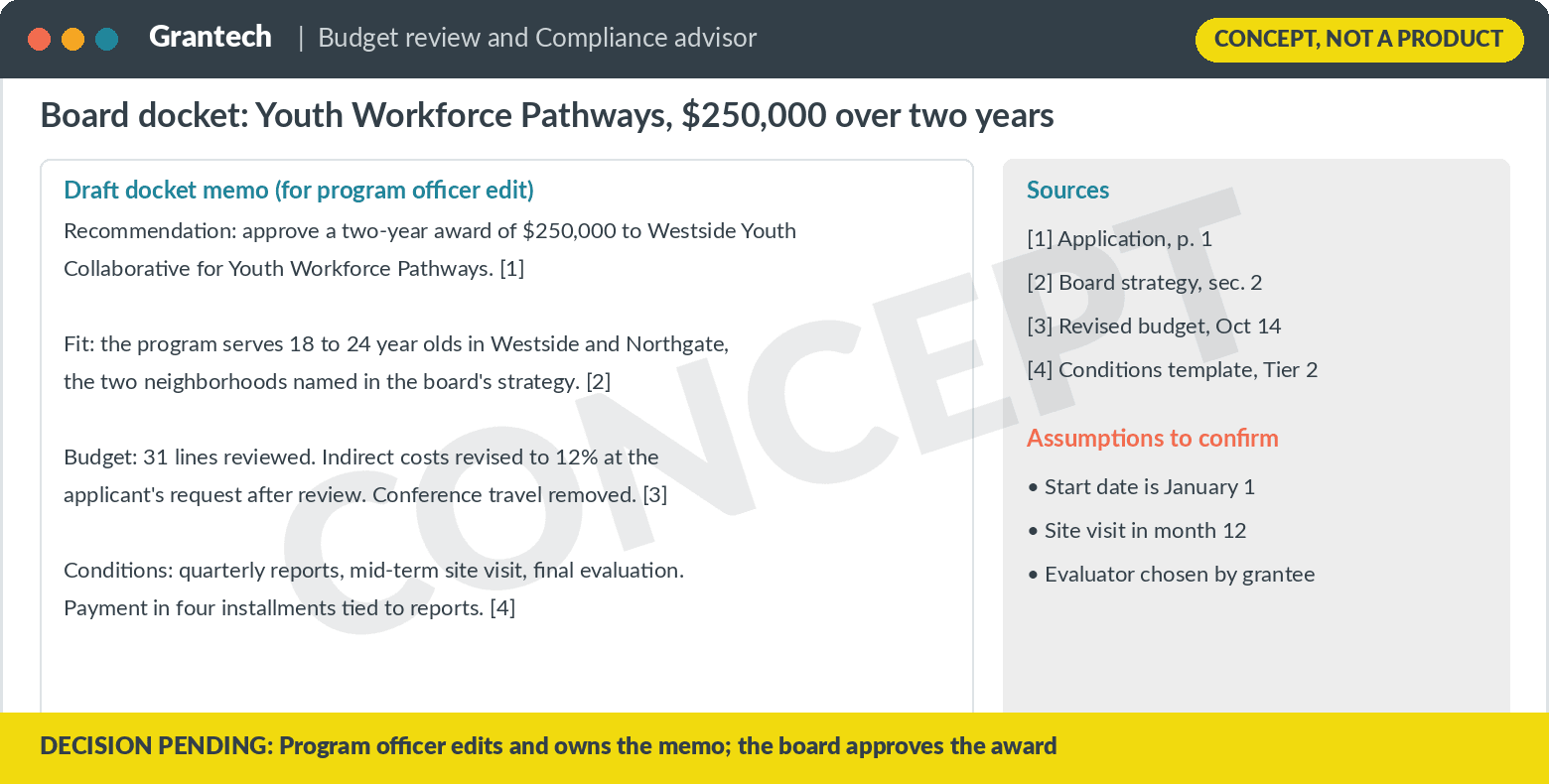
See how the five stages play out on one fictional grant, with the agent’s work and the staff decisions side by side.
See one grant, start to finishPlatform and apps
The Zenius AI ecosystem
Zenius runs its own business on this platform.Every app below inherits the same controls we build for clients.
Identify the work
Zenius CRM
In useAccounts, contacts, pipeline, and agency intelligence in one governed workspace.
Pursue the work
Zenius Capture
In useGate-driven capture plans, living win probability, competitor intelligence, and an intake agent.
Win the work
Zenius Proposal
In useA reference vault of past work, evidence-graded bid decisions, compliant drafts, and red teams.
Deliver the work
Zenius Helm
In use on client deliveryProject execution: cited obligations, evidence-based status, meetings turned into actions, a project ledger.
Track the work
Zenius Time
In use on client deliveryDCAA-compliant timekeeping with approvals, edit history, e-signatures, and period-of-performance controls.
Connect the work
Zenius Nerve
In useOrganizational memory of commitments, decisions, risks, and relationships, with a weekly executive brief.
Staff the work
Billet
In developmentA GovCon talent network: AI matching to a PWS or labor category, consent-verified candidates.
Support the work
Zenius Assist
In developmentAn AI helpdesk that proposes category, priority, and routing. A person confirms before anything moves.
Grow the team
Zenius HR
Next in the pipelineHuman resources for a growing firm, on the same governed platform as everything above.
Run the books
Zenius Finance
Next in the pipelineFinance and project accounting, on the same governed platform as everything above.
The platform underneath
Zenius AI Gateway
Running at Zenius todayOne door for every AI call. Routes models by configuration, attributes cost, and blocks sensitive data bound for an unapproved model, with an audit record.
Command Center
Running at Zenius todayThe leadership cockpit: spend by app, feature, user, and model; budgets; policy blocks; audit views; agent-run tracing on OpenTelemetry.
Platform Contracts
Running at Zenius todayVersioned rules every app follows: C0 to C5 data classification, telemetry, cost attribution, identity and roles.
Starter Kit and Playbook
Running at Zenius todayEvery new app starts governed on day one, with tested runbooks.
Deployed in your tenant. Each client gets a private copy of the platform in its own cloud, with no shared infrastructure.
Start small
Three ways to begin
- 1
AI Readiness Review
About two weeks, facilitated
Pairs with the AI Readiness & Governance domain in GMMI.
- 2
Pilot one workflow
Six to eight weeks, measured
One high-volume, checkable step. A person signs every result. Time and errors are measured against the current process.
- 3
Governed AI operations
Ongoing
Zenius runs AI-assisted grants operations on your tenant, with cost visibility, an audit trail, and human sign-off.
What is real today, and what is next
Running today
- The governed platform: one gateway, cost attribution, and a full audit record.
- Command Center, the leadership cockpit for AI spend, policy, and audit.
- GMMI and the free Snapshot.
- Grants Managed Services, including audit support, in delivery at a federal grant-making agency, where every AI output is reviewed and accepted by a named person before use.
In development
- The Grantech reasoning agents, in the order the build plan sets.
- The shared grants knowledge base they work from.
- A layer above existing grants systems that replaces none of them.
Why Zenius
$200B+ annually
Grant portfolio supported at the U.S. Department of Education
40,000 grantees
Served by the programs we helped modernize
Since 2018
At the U.S. Department of Education
Since 2017
GMMI in use
HUBZone-certified, Minority-Owned, GSA MAS 47QTCA20D00CC, Leesburg, Virginia.
Start with one workflow.
Bring us the slowest, most error-prone, most audited step in your grant process.We’ll show you what it looks like with a governed agent and a person in charge.
Visit us at FluxxCon 2026, Booth 8.